Tag: SALES FUNNELS

  • Why Your Website Isn’t Converting SEO funnels

    Why Your Website Isn’t Converting | SEO-Optimized Funnels Nigeria
    Home / Blog / Why Your Website Isn’t Converting (And How SEO-Optimized Funnels Fix It)
    SEO

    Why Your Website Isn’t Converting (And How SEO-Optimized Funnels Fix It)

    Anyiam Kennedy
    Anyiam Kennedy
    Founder, Scaling Funnels · 7 min read

    A surprising number of Nigerian businesses have websites that get decent traffic and still generate almost no leads. The traffic isn’t the problem — the website simply wasn’t built to convert it. There’s a real difference between a website that ranks and a funnel that’s built to turn a visitor into a lead.

    Most Websites Are Built Like Brochures

    A typical small business website has a homepage, an “About Us” page, a services page, and a contact page — structured like a printed brochure rather than a path toward a decision. Visitors land, look around, and leave, because nothing on the page actually asks them to do anything specific.

    SEO Traffic Without A Clear Offer Is Wasted Traffic

    Ranking on Google brings visitors to your site, but ranking alone doesn’t convert them. If there’s no clear, single offer above the fold — no obvious next step — you’re paying (in time or money) for traffic that has nowhere useful to go once it arrives.

    What An SEO-Optimized Funnel Does Differently

    Instead of a generic homepage, an SEO-optimized funnel is built around a specific keyword, a specific audience, and a specific offer — all pointing toward one clear action, whether that’s booking a call, requesting a quote, or starting a conversation on WhatsApp. The SEO brings the visitor in; the funnel structure gives them a reason to act once they’re there.

    Page Speed Quietly Kills Conversions

    A slow-loading website loses visitors before they even see the offer, particularly on mobile data connections common across Nigeria. Search engines also factor load speed into rankings, so a slow site is losing on two fronts at once — visibility and conversion.

    Mobile Experience Isn’t Optional

    The overwhelming majority of Nigerian web traffic comes from mobile devices. A website that was designed primarily for desktop and simply “shrinks” on mobile will frustrate the exact audience it needs to convert most.

    Bringing It Together

    Search visibility gets someone to your website. Conversion is a separate skill — clear structure, a specific offer, fast load times, and a mobile-first design that makes it easy to take the next step. A website only becomes a real lead generation asset when both are built together, not treated as two separate projects.

    Before investing further in SEO or ad spend to drive more traffic, it’s worth auditing whether the website itself is actually built to convert the visitors it already gets. Often, fixing the funnel structure produces a bigger lift in leads than doubling the traffic ever would.

    Anyiam Kennedy

    Anyiam Kennedy — The Funnel Messiah

    Founder of Scaling Funnels. 3+ years in direct response copywriting, sales, and business automation, with an MSc in Neuroanatomy informing how he builds funnels around real human decision-making.

    Want a system like this running in your business?

    Book a strategy session and we’ll map out exactly what to build first.

    Get Started
    Get Started
  • WhatsApp Automation: The Missing Piece In Most Nigerian Sales Funnels

    WhatsApp Automation For Nigerian Sales Funnels | Scaling Funnels
    Home / Blog / WhatsApp Automation: The Missing Piece In Most Nigerian Sales Funnels
    Automation

    WhatsApp Automation: The Missing Piece In Most Nigerian Sales Funnels

    Anyiam Kennedy
    Anyiam Kennedy
    Founder, Scaling Funnels · 6 min read

    Most Nigerian sales funnel guides are written around email sequences — welcome emails, drip campaigns, abandoned cart reminders. The problem is simple: that’s not where most Nigerian customers actually want to talk to a business. They want to talk on WhatsApp.

    Why WhatsApp Beats Email For Nigerian Businesses

    Email open rates in Nigeria tend to be low, and inboxes are often checked infrequently. WhatsApp, by contrast, gets opened almost immediately. A funnel that ends at a “thank you, check your email” page is handing a warm lead back into silence.

    What WhatsApp Automation Actually Looks Like

    It’s not just auto-replies. Done properly, WhatsApp automation can instantly acknowledge a new lead, ask a qualifying question, share available appointment times, send a reminder before a booked call, and follow up automatically if someone goes quiet — without a human touching every single conversation.

    The Gap It Closes

    The moment between someone showing interest and someone actually booking a call is where most leads are lost — not because they weren’t interested, but because nobody responded fast enough. WhatsApp automation closes that gap in minutes instead of hours, which matters enormously when a prospect is comparing you to two other businesses at the same time.

    Where It Fits Into A Bigger System

    WhatsApp automation works best when it’s connected to a CRM, not running as a standalone tool. That way, every conversation updates a lead’s status automatically, and your team can see exactly where each prospect is in the pipeline without switching between apps.

    A Word Of Caution

    Automation should feel helpful, not robotic. The goal isn’t to remove the human element entirely — it’s to make sure no lead waits in silence, while still handing the conversation to a real person the moment it needs a human touch. Over-automating a conversation that clearly needs a person can do more damage than having no automation at all.

    Getting Started Without Overcomplicating It

    You don’t need every automation running on day one. Most businesses see the biggest improvement just from automating the very first reply and the appointment reminder — the two moments where slow, manual responses cost the most leads. Everything else can be layered in once those are working reliably.

    The Bottom Line

    If your funnel doesn’t include WhatsApp automation, it’s likely missing the channel your customers actually prefer. For most Nigerian businesses, that single gap accounts for a meaningful share of leads that go cold simply from being answered too slowly. Fixing it is often one of the fastest wins available in an existing funnel.

    Anyiam Kennedy

    Anyiam Kennedy — The Funnel Messiah

    Founder of Scaling Funnels. 3+ years in direct response copywriting, sales, and business automation, with an MSc in Neuroanatomy informing how he builds funnels around real human decision-making.

    Want a system like this running in your business?

    Book a strategy session and we’ll map out exactly what to build first.

    Get Started
    Get Started
  • The Psychology Behind Why People Buy: A Founder’s Perspective

    The Psychology Behind Why People Buy | Scaling Funnels
    Home / Blog / The Psychology Behind Why People Buy: A Founder’s Perspective
    Sales Psychology

    The Psychology Behind Why People Buy: A Founder’s Perspective

    Anyiam Kennedy
    Anyiam Kennedy
    Founder, Scaling Funnels · 9 min read

    Before building funnels, I spent years studying two very different things: direct response copywriting, and the human brain itself through an MSc in Neuroanatomy. They turned out to be more connected than I expected. Both are ultimately about the same question — why does a person decide to act, and what makes them hesitate?

    People Don’t Buy Products. They Buy A Resolution To Tension

    Nobody wakes up wanting a CRM or a website. They wake up frustrated that leads keep slipping away, or anxious that their business isn’t growing fast enough. A sale happens when a person believes your offer resolves that specific tension — not because the product itself is impressive on paper.

    Hesitation Is Rarely About Price

    Price objections are often a stand-in for a deeper uncertainty: “Will this actually work for a business like mine?” or “What if I commit and it doesn’t change anything?” A funnel that only addresses price with a discount is treating the symptom, not the actual hesitation.

    The Brain Trusts Specificity Over Superlatives

    Vague claims like “the best service in Nigeria” trigger skepticism, because the brain has learned to discount language that sounds like marketing. Specific, concrete claims — a clear process, a named step-by-step system, an exact description of what happens next — are processed very differently, and tend to build trust faster.

    Decisions Are Made Emotionally, Then Justified Logically

    This isn’t a manipulation trick — it’s simply how human decision-making works. People feel drawn toward a decision first, based on trust and emotional resonance, and then look for logical reasons to justify it. A funnel needs both: language that builds genuine emotional trust, and clear logical proof points once that trust exists.

    Why This Matters More Than Design

    A beautifully designed funnel with the wrong psychology will still underperform a plain one that speaks directly to what a prospect is actually feeling. Design earns attention. Psychology earns the decision. That’s the order most funnels get backwards — polishing the visuals while leaving the actual reasoning behind the offer untouched.

    Building This Into Every System We Build

    This is the thinking behind every funnel, CRM sequence, and automation workflow we build at Scaling Funnels — not decoration on top of a sales process, but the actual mechanism that moves someone from curious to convinced. Understanding why people say yes isn’t a nice-to-have in a funnel. It’s the entire job — and it’s the difference between a funnel that merely looks professional and one that actually converts.

    Anyiam Kennedy

    Anyiam Kennedy — The Funnel Messiah

    Founder of Scaling Funnels. 3+ years in direct response copywriting, sales, and business automation, with an MSc in Neuroanatomy informing how he builds funnels around real human decision-making.

    Want a system like this running in your business?

    Book a strategy session and we’ll map out exactly what to build first.

    Get Started
    Get Started
  • 7 Lead Generation Strategies That Work For Nigerian SMEs

    7 Lead Generation Strategies For Nigerian SMEs | Scaling Funnels
    Home / Blog / 7 Lead Generation Strategies That Work For Nigerian SMEs
    Lead Generation

    7 Lead Generation Strategies That Work For Nigerian SMEs

    Anyiam Kennedy
    Anyiam Kennedy
    Founder, Scaling Funnels · 8 min read

    Lead generation advice online is often written for a completely different market — one where email is the primary channel and Google Ads budgets run into the thousands of dollars. Nigerian SMEs need strategies that match how their actual customers search, communicate, and buy.

    1. Click-To-WhatsApp Ads

    Rather than sending traffic to a form that feels like a dead end, click-to-WhatsApp ads let a prospect start a real conversation immediately. For service-based businesses especially, this consistently outperforms a cold contact form.

    2. Local SEO On Google Business Profile

    Many Nigerian SMEs completely ignore their Google Business Profile, even though it’s free and shows up directly when someone searches for their service nearby. Photos, accurate categories, and regular updates make a measurable difference in visibility.

    3. A Lead Magnet That Solves One Specific Problem

    Generic “sign up for updates” offers rarely convert. A lead magnet that solves one narrow, specific problem — a checklist, a short guide, a calculator — gives people a real reason to hand over their contact details.

    4. Referral Systems With A Clear Incentive

    Word of mouth already works in Nigeria’s relationship-driven business culture. Formalizing it with a clear, simple incentive turns an occasional referral into a repeatable lead source.

    5. Retargeting Website Visitors Who Didn’t Convert

    Most first-time visitors won’t buy immediately. Retargeting ads that follow up with people who visited but didn’t take action recover leads that would otherwise be lost for good.

    6. Partnering With Complementary (Not Competing) Businesses

    A wedding planner and a photographer aren’t competitors — they share the same audience. Cross-referral partnerships with businesses that serve the same customer at a different stage can generate consistent, low-cost leads.

    7. Short-Form Video Showing The Work, Not Just The Offer

    Nigerian audiences respond strongly to video that shows real work happening — a consultation, a finished project, a behind-the-scenes look — rather than polished sales pitches. It builds trust faster than static ads.

    The Strategy That Actually Matters Most

    None of these strategies work in isolation if there’s no system capturing and following up on the leads they generate. The businesses that get the most out of lead generation are the ones that pair it with a funnel and CRM built to catch every lead these strategies bring in — not just the ones who happen to follow up in time.

    Picking two or three of these strategies and running them consistently for a few months will almost always outperform trying all seven at once with no system to support them.

    Anyiam Kennedy

    Anyiam Kennedy — The Funnel Messiah

    Founder of Scaling Funnels. 3+ years in direct response copywriting, sales, and business automation, with an MSc in Neuroanatomy informing how he builds funnels around real human decision-making.

    Want a system like this running in your business?

    Book a strategy session and we’ll map out exactly what to build first.

    Get Started
    Get Started
  • How to Increase Conversion Rate by 50% Using Sales Funnels

    How to Increase Conversion Rate by 50% Using Sales Funnels

    In today’s competitive digital landscape, simply driving traffic to your website isn’t enough. Businesses that master sales funnels can dramatically improve their conversion rates. Many companies achieve a 50% or higher increase in conversions by optimizing their funnel stages. A well-designed sales funnel guides prospects from awareness to purchase, reducing drop-offs and maximizing revenue.

    What Is a Sales Funnel and Why Does It Matter?

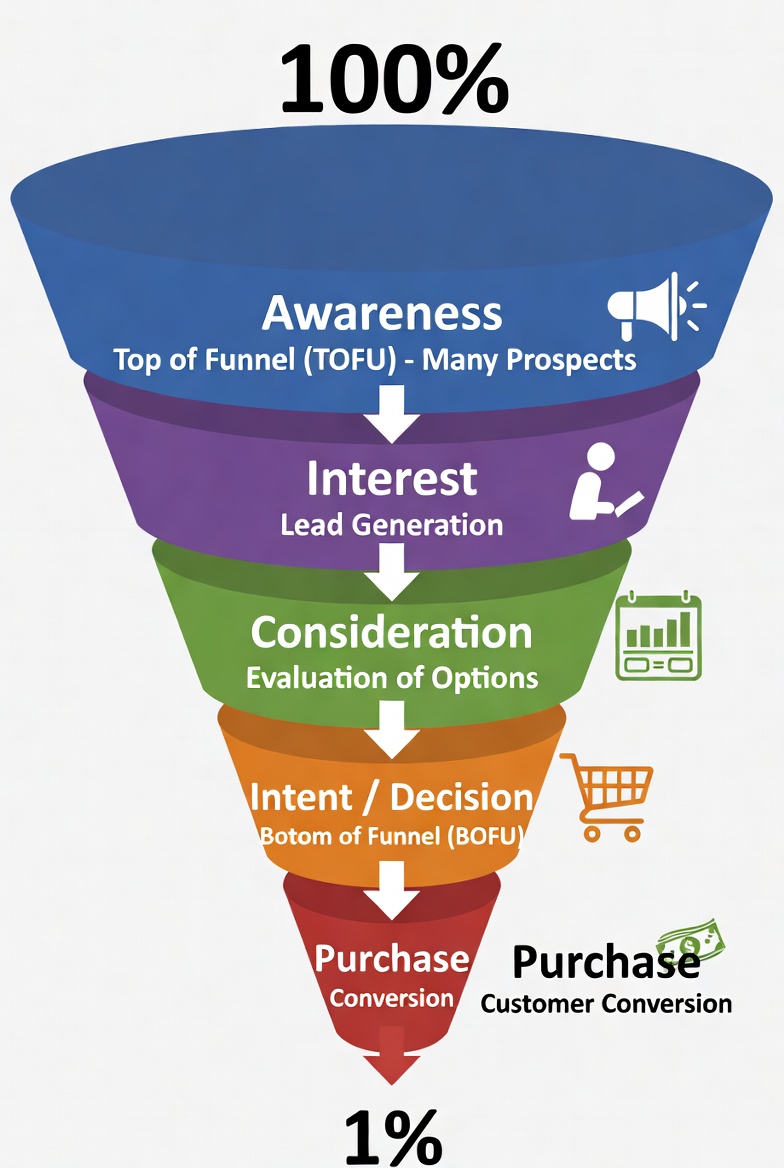
    A sales funnel is a visual representation of the customer journey. It starts wide at the top with many visitors and narrows as qualified leads move toward buying. Typical stages include Awareness, Interest, Consideration, Decision, and Purchase.

    Without optimization, most businesses lose 96-99% of visitors before they convert. Strategic funnel improvements—targeting leaks at each stage—can realistically boost conversions by 50% or more.

    5 Proven Strategies to Boost Conversions with Sales Funnels

    1. Optimize the Top of the Funnel (TOFU) for Better Lead Quality
    Focus on attracting the right audience through targeted content marketing, SEO, and paid ads. Create high-value lead magnets like ebooks, webinars, or free tools. Use precise audience targeting to improve visitor-to-lead conversion from the start. Companies that refine TOFU messaging often see 20-30% better downstream results.

    2. Build Trust and Engagement at the Interest & Consideration Stages
    Nurture leads with automated email sequences, personalized retargeting ads, and educational content. Address objections early by showcasing testimonials, case studies, and detailed product comparisons. Implement chatbots or live chat for instant answers. This stage is where many funnels leak—fixing it can deliver massive conversion lifts.

    3. Simplify the Decision Stage with Strong CTAs and Social Proof
    Make buying frictionless. Use urgency (limited-time offers), scarcity, and one-click checkout options. Display guarantees, reviews, and trust badges prominently. A/B test multiple versions of your offer pages. Small changes here frequently produce outsized gains in conversion rates.

    4. Analyze Data and Plug the Leaks
    Use tools like Google Analytics, Hotjar, or CRM platforms to track drop-off points. Identify where prospects abandon the funnel and test fixes. Heatmaps often reveal confusing navigation or weak calls-to-action. Regular funnel audits help maintain steady improvements toward that 50% goal.

    5. Retarget and Focus on Post-Purchase Retention
    Don’t stop at the first sale. Create a loyalty stage with upsells, cross-sells, and excellent onboarding. Remarketing to past visitors and customers can recover lost conversions and turn one-time buyers into repeat customers. This bottom-funnel optimization compounds results over time.

    Real-World Results

    Businesses implementing full-funnel optimization commonly report 40-70% conversion increases within months. Ecommerce stores refining checkout flows and SaaS companies improving onboarding see especially strong gains.

    Start Optimizing Your Sales Funnel Today

    Increasing conversions by 50% using sales funnels requires consistent testing, customer understanding, and iteration. Map your current funnel, identify weak points, and implement changes stage by stage.

    Ready to transform your results? Audit your sales process this week and begin testing one optimization per stage. Track metrics carefully—you may be surprised how quickly your conversion rate climbs.

    (Word count: 498)

    Related searches: sales funnel optimization, conversion rate optimization strategies, boost online sales 2026.

    Implement these tactics and watch your business grow!

  • Why Sales Funnels Are the Easiest Way to Scale Any Business in Nigeria

    Why Sales Funnels Are the Easiest Way to Scale Any Business in Nigeria

    Growing a business is not just about getting more customers. It is about creating a system that consistently attracts leads, nurtures prospects, and converts them into paying customers without requiring constant manual effort.

    Unfortunately, many businesses in Nigeria still rely on referrals, social media posts, WhatsApp messages, and manual follow-ups to generate sales. While these methods can work, they are difficult to scale because they depend heavily on the business owner’s time and availability.

    This is why more businesses are turning to sales funnels.

    A well-designed sales funnel creates a predictable path that guides potential customers from their first interaction with your brand to becoming loyal paying clients. It automates key parts of the sales process and allows businesses to grow faster while reducing wasted time and lost opportunities.

    What Is a Sales Funnel?

    A sales funnel is a structured marketing and sales system designed to move prospects through different stages of the buying journey.

    These stages typically include:

    • Awareness
    • Interest
    • Consideration
    • Decision
    • Purchase

    Instead of leaving customer acquisition to chance, a sales funnel strategically guides prospects toward taking action.

    Whether someone finds your business through Google, Facebook, Instagram, LinkedIn, TikTok, or a referral, the funnel ensures they receive the right information at the right time.

    Why Most Nigerian Businesses Struggle to Scale

    Many businesses experience growth challenges because they lack systems.

    Common problems include:

    • Slow response times
    • Poor lead management
    • Inconsistent follow-ups
    • Missed sales opportunities
    • Lack of customer tracking
    • Dependence on manual processes

    Every day, businesses lose potential customers simply because nobody followed up after the initial inquiry.

    Without a structured sales process, scaling becomes difficult because growth creates more complexity instead of more profit.

    Sales Funnels Capture and Organize Leads Automatically

    One of the biggest advantages of a sales funnel is automated lead capture.

    Instead of relying on prospects to remember your business, funnels collect contact information through:

    • Landing pages
    • Lead forms
    • Free consultations
    • Downloads
    • Special offers
    • Webinar registrations

    Every lead is automatically stored in a CRM system where follow-up can begin immediately.

    This ensures no opportunity is lost and every prospect enters a structured customer journey.

    Automated Follow-Ups Increase Conversions

    Studies consistently show that most customers do not buy during their first interaction with a business.

    Many require multiple touchpoints before making a decision.

    Sales funnels solve this problem through automation.

    Once a lead enters the funnel, they can automatically receive:

    • Email sequences
    • SMS reminders
    • Appointment confirmations
    • Educational content
    • Customer testimonials
    • Promotional offers

    This continuous engagement builds trust and keeps your business top of mind.

    Instead of manually chasing prospects, the system does the work for you.

    Sales Funnels Turn Website Visitors into Paying Customers

    Most websites simply provide information.

    A sales funnel is designed to generate action.

    Every page has a specific goal:

    • Capture leads
    • Book appointments
    • Schedule consultations
    • Generate purchases
    • Collect customer information

    By removing distractions and focusing visitors on one clear action, funnels typically convert at significantly higher rates than traditional websites.

    This means more revenue from the same amount of traffic.

    Sales Funnels Create Predictable Business Growth

    One major challenge business owners face is uncertainty.

    Without data, it becomes difficult to predict future revenue.

    A sales funnel provides valuable insights into:

    • Website traffic
    • Lead generation performance
    • Conversion rates
    • Cost per lead
    • Customer acquisition costs
    • Revenue generated

    With these metrics, businesses can make smarter decisions and forecast growth more accurately.

    When you know your numbers, scaling becomes much easier.

    Sales Funnels Save Time and Reduce Workload

    Business owners often become overwhelmed because every inquiry requires manual attention.

    As demand increases, so does the workload.

    A properly built funnel automates repetitive tasks such as:

    • Lead capture
    • Appointment scheduling
    • Follow-up messages
    • Customer nurturing
    • Sales tracking

    This allows business owners to focus on serving clients and growing the business rather than constantly managing administrative tasks.

    Why Businesses Need a Sales Funnel Agency in Nigeria

    Building a high-converting sales funnel requires more than creating a landing page.

    Successful funnels combine:

    • Conversion-focused design
    • Persuasive copywriting
    • CRM integration
    • Marketing automation
    • Lead nurturing systems
    • Analytics and tracking

    This is why many businesses choose to work with a professional Sales Funnel Agency in Nigeria.

    An experienced agency can design and implement systems that generate leads consistently while improving customer acquisition and retention.

    Conclusion

    The fastest-growing businesses today are not necessarily those with the largest budgets. They are the ones with the most efficient systems.

    Sales funnels automate lead generation, improve follow-up, increase conversions, and create predictable revenue streams.

    Instead of depending on manual sales efforts, businesses can build a system that works around the clock to attract, nurture, and convert customers.

    If you want to scale your business without increasing your workload, investing in a professionally designed sales funnel may be one of the smartest decisions you can make.

    Frequently Asked Questions

    What is a sales funnel?

    A sales funnel is a step-by-step process that guides potential customers from discovering your business to making a purchase.

    How can a sales funnel help my business grow?

    Sales funnels automate lead generation, follow-up, and customer nurturing, resulting in higher conversion rates and increased revenue.

    Do small businesses need sales funnels?

    Yes. Sales funnels help businesses of all sizes generate more leads, improve customer acquisition, and scale more efficiently.

    How much does it cost to build a sales funnel in Nigeria?

    Costs vary depending on the complexity of the funnel, automation requirements, CRM integrations, and marketing objectives.

    What is the best sales funnel software?

    Popular options include GoHighLevel, ClickFunnels, HubSpot, ActiveCampaign, and Systeme.io. The best choice depends on your business goals and budget.